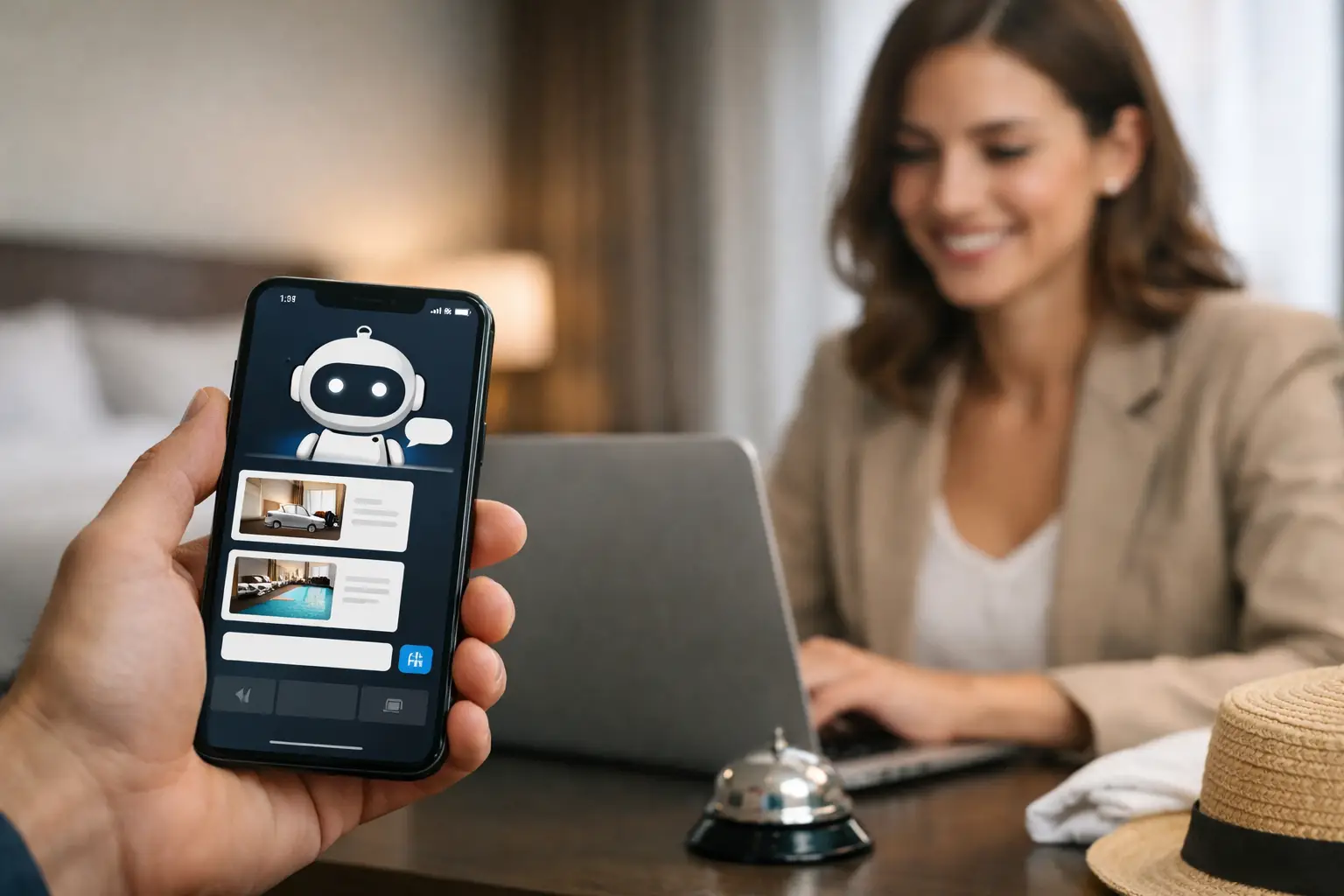
A guest lands on your hotel website at 10:47 PM, asks if late check-in is possible, wants a family room for two nights, and hesitates for just a moment before leaving. That is exactly where a strong hotel chatbot booking example becomes useful - not as a gimmick, but as a practical booking layer that answers, qualifies, and moves the guest toward a confirmed reservation.
For hotels, the value is simple. Many booking opportunities are lost in the gap between a guest question and a staff response. Phone lines are busy, front desk teams are handling arrivals, and inboxes pile up. A chatbot can close that gap when it is designed around actual booking behavior, connected to the right systems, and written in the language your guests naturally use.
What a good hotel chatbot booking example looks like
The best hotel chatbot flows do not try to do everything. They focus on a few high-value tasks and do them well. In a hotel setting, that usually means checking availability, collecting stay details, answering common booking questions, and guiding the guest to the next step without friction.
Imagine a guest opens the chat and types: "I need a room in Helsinki next Friday and Saturday for two adults and one child." A useful chatbot does not respond with a generic menu. It recognizes the booking intent, confirms the dates, asks one missing question if needed, and either shows suitable room options or passes the request into the hotel booking flow.
It might respond like this:
"I can help with that. You need a room for 2 adults and 1 child from Friday, May 17 to Sunday, May 19. Do you want breakfast included?"
That small detail matters. The chatbot is not just chatting. It is moving the reservation forward.
Why this matters more than another contact form
A contact form collects interest. A booking chatbot handles intent in the moment.
That difference affects conversion. Guests often have one or two small concerns that delay a booking: parking, pet policy, cancellation terms, airport transfer, room size, or check-in time. If those answers arrive instantly, more guests continue. If they need to wait until morning, some will book elsewhere.
This is where many hotels misjudge automation. They assume a chatbot is mostly a support tool. In practice, it often performs best as a sales and operations assistant. It reduces repetitive questions for staff while increasing the number of guests who reach the reservation stage with confidence.
A practical hotel chatbot booking example
Here is a realistic flow for a mid-size hotel that wants to capture direct bookings from its website.
Step 1: The chatbot opens with relevance
Instead of saying, "How can I help you today?" the chat starts with a booking-oriented prompt:
"Looking for a room, check-in details, or help with an existing reservation?"
This keeps the interaction focused. It also helps separate new booking requests from support questions.
Step 2: The guest states intent in natural language
The guest writes: "Need 2 rooms next weekend for 4 adults, arriving late."
The chatbot extracts the key details - dates, room count, guest count, and special note about arrival time. If one detail is unclear, it asks only for that. It does not push the guest through five unnecessary steps.
Step 3: The chatbot answers booking blockers
Before the guest commits, the chatbot can handle questions such as:
- Is late check-in available?
- Do you have parking?
- Is breakfast included?
- Can I book connecting rooms?
These are not side questions. They are often the reason a booking either happens or stalls.
Step 4: The chatbot moves into reservation capture
Depending on the setup, the chatbot can direct the guest into the hotel booking engine, prefill details, or collect the lead for staff follow-up. In more advanced cases, it can also create or update reservation records through a connected system.
The best option depends on the hotel's current stack. For some properties, a lightweight add-on approach is the right move. For others, deeper integration makes sense. The important point is that the chatbot should fit existing operations rather than forcing a full rebuild.
Step 5: The handoff is clear when needed
Not every booking should stay fully automated. Group bookings, long stays, special accessibility requests, and edge cases often need a person. A well-built chatbot recognizes that early and hands over context cleanly so the guest does not need to repeat everything.
That is the difference between helpful automation and frustrating automation.
What makes a chatbot convert better in hospitality
Speed matters, but speed alone is not enough. A hotel chatbot needs to reflect how guests actually make booking decisions.
First, the language must be natural. Guests do not think in database fields. They ask, "Can we bring a dog?" or "Do you have a quiet room away from the elevator?" A good chatbot handles those questions without sounding scripted.
Second, the flow must stay short. Hotels lose momentum when the chat becomes a questionnaire. If the guest wants to book, the chatbot should gather only what is needed to move them forward.
Third, multilingual support can make a real difference, especially in hospitality. For hotels serving international guests, the ability to answer booking questions in multiple languages is not a nice extra. It can remove friction at the exact point where trust matters.
Fourth, the answers need operational accuracy. If the chatbot gives the wrong breakfast hours, room policy, or check-in rule, it creates avoidable service issues. Good chatbot projects are built with operational input, not just marketing copy.
Where hotels often get it wrong
Many chatbot projects fail for very ordinary reasons. The first is overdesign. A hotel does not need a flashy AI assistant with dozens of features if basic booking questions still lead to dead ends.
The second is poor integration. If the chatbot sits outside the booking flow and cannot pass useful data forward, it becomes another channel staff have to manually monitor. That increases workload instead of reducing it.
The third is weak conversation design. Hospitality requires clarity, tone control, and context. A chatbot should sound helpful and efficient, not overly casual or strangely robotic.
There is also a timing issue. Some hotels launch a chatbot before agreeing internally on what it should handle. If front desk, reservations, and marketing all expect different outcomes, the experience becomes inconsistent. The practical fix is to define the top booking and support use cases first, then build around those.
How to evaluate a hotel chatbot booking example for your business
If you are considering a chatbot for hotel bookings, do not start with features. Start with the specific operational gap you want to fix.
Maybe your team is missing after-hours inquiries. Maybe direct booking conversion is weaker than expected because guests have too many unanswered questions. Maybe staff spend hours every week replying to the same availability and policy requests. Each of these points leads to a different chatbot design.
A useful evaluation usually comes down to five questions. Can it capture booking intent quickly? Can it answer the most common pre-booking questions accurately? Can it connect with your current tools without creating extra manual work? Can it hand off edge cases cleanly? And can your team update content without turning every small change into a development project?
Those questions are more valuable than a long feature checklist.
A realistic rollout approach
The fastest path is usually not a large transformation project. It is a focused pilot with a narrow scope, such as direct website booking inquiries, late check-in questions, and common reservation FAQs.
That gives the hotel a chance to test real guest behavior, identify the drop-off points, and improve the flow based on actual conversations. It also lowers implementation friction because the chatbot can work as an add-on to existing systems.
This is where a practical development partner matters. AI Powered Solutions, for example, builds around current business operations instead of forcing replacement, which is often the right approach for hotels that need faster response times and measurable process gains without slowing down daily operations.
The real benchmark for success
A strong hotel chatbot is not successful because it sounds clever. It is successful if more guests get answers fast, more booking intent gets captured, and staff spend less time repeating the same information.
That is why the best hotel chatbot booking example is usually the simplest one that works reliably. Clear booking prompts. Accurate answers. Smart handoff. Useful integration. Nothing extra for the sake of novelty.
If a hotel can give guests the confidence to continue their reservation at the exact moment they are ready to book, the chatbot is doing its job.